The Panorama Ridge
Trailhead: The trail starts at the Rubble Creek parking lot, 33km north of
Squamish (or 25km south of Whistler) on Highway 99. There's a fee for parking (cards
are accepted), though at the weekend "parking" will likely amount to abandoning your
vehicle a few hundred yards back down the road.
Distance: About 17.5 miles out and back by the most direct route, with
1500m (5000 feet) of elevation gain.
There is no shortage of panorama points, ridges and peaks out there (though
there are even more sunset and sunrise points!), and not all of them are
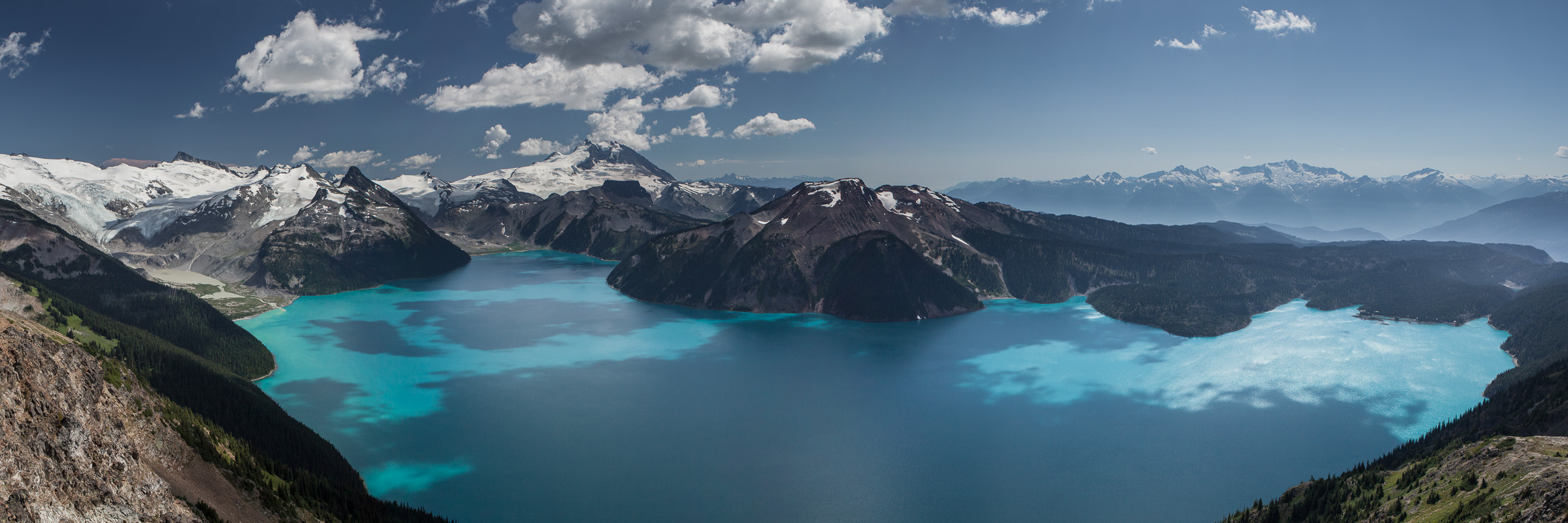
worth a visit. Garibaldi's Panorama Ridge, however, lives up to its name. The
trail there - by most accounts the best long day hike or short backpack in the southern
Coast Mountains - attains an astounding (and, yes, panoramic) vantage that rivals any
I've seen in North America. If you only do one hike in Garibaldi Provincial Park, this should
surely be the one.
The hike to the Panorama Ridge begins at the Rubble Creek trail head. From here there are 5 miles and
890 meters (3000 feet) of climbing before the trail emerges from the trees at the Taylor Meadows
campground. The grade is steady and the trail is in excellent shape, but even so this first section
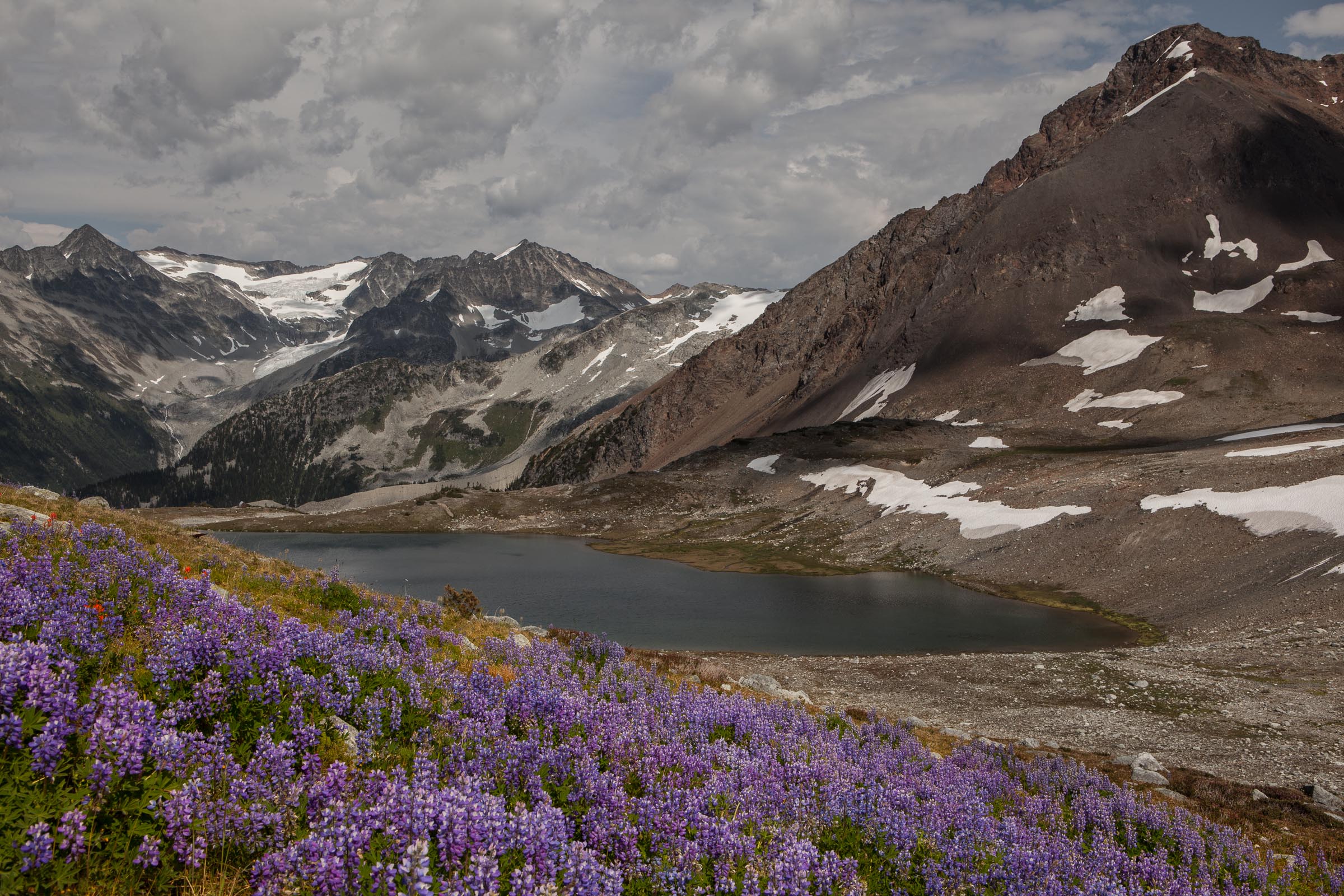
is undeniably tedious. Once past Taylor Meadows, however, the exertion starts to pay off as views
of snowy peaks emerge and the trail traverses (in late July) some of the richest wildflower meadows I've
ever seen.
Continuing onward, the trail remains fairly flat as you past, first, the fork leading to the
Black Tusk (the odd looking formation seen in the right hand photo above) and then a small
lake that lies on the back side of the Panorama Ridge. Turning right past the lake the
route then turns upward once more, gaining about 1000 feet in a steep ascent past
(or across) any lingering snow to reach the crest of the ridge. The view from here is
magnificent: Mount Garibaldi, the Tantalus Range, and the Black Tusk frame the
intense blue of Garibaldi Lake to form a 360 degree view of what looks like endless wilderness.
From the top, it's possible to hike further along the ridge to the east (in principle as
far as the Helm Glacier). Returning, you can either retrace your steps back through Taylor
Meadows or detour via the shore of Garibaldi Lake.
We did this as a day hike, and as long as you're up for a long and strenuous day this is
the option I'd recommend. Taylor Meadows looks like a nice campground, but to reach there
backpacking would require hauling a pack up the first five miles of steep and boring trail! If you do
camp, though, make sure to spend a second day hiking the Black Tusk, which also looks
like a great hike.
Musical Bumps trail to Singing Pass
Trailhead: We started at the Whistler gondola's upper station (the ride up
leaves from Whistler Village), and looped back to the Village via Fitzsimmons
Creek. Old guidebooks suggest you can drive part-way along the creek but it
ain't so - a landslide has rendered the old road impassable.
Distance: 16.5 miles (mostly but by no means entirely downhill) if done as
the near-loop described below. Alternatively,
it's 12 miles out and back to Singing Pass from the top of the gondola.
This hike is tailor-made for any environmentally conscious but borderline
slothful hikers out there. It's green because the loop starts and ends
in Whistler Village - no driving required - and great if you hate climbing
since the Whistler gondola makes short work of what would otherwise be a
gruelling 1100m ascent. Of course there is a price to be paid for this
convenience: the lift ticket is expensive and the ease of access means
that the trails are busy, especially near the drop-off point for the
gondola.
The Musical Bumps trail - so-called because the minor summits along the crest of the
ridge are named after orchestral instruments - provides the easiest access to open
alpine scenery in Garibaldi Provincial Park. From the top station of the gondala
miles of moderate hiking traverse a succession of small meadows and peaks en route
(ultimately) to Singing Pass and Russet Lake. The mountains here are beautiful, and it
would be possible to fashion a good out-and-back hike of whatever length you liked
by taking the gondola both up and down the mountain. We opted instead to hike as
far as Singing Pass, and then made a partial loop by backtracking along the
Fitzsimmons Creek trail down to Whistler Village. This option is only partially
recommended - the trail along the valley of Fitzsimmons Creek passes through an
attractive but seemingly interminable forest - but overall this was still a good day hike
amid excellent scenery.
Wedgemount Lake
Trailhead: Wedgemount Lake trailhead at the end of Wedge Creek FS road. The
signed turnoff is about 12km north of Whistler Village. The road is unpaved but readily
passable (as of summer 2009) in a regular car.
Distance: 9 miles round trip to the lake, with 1160m (3800 feet) of
elevation gain.
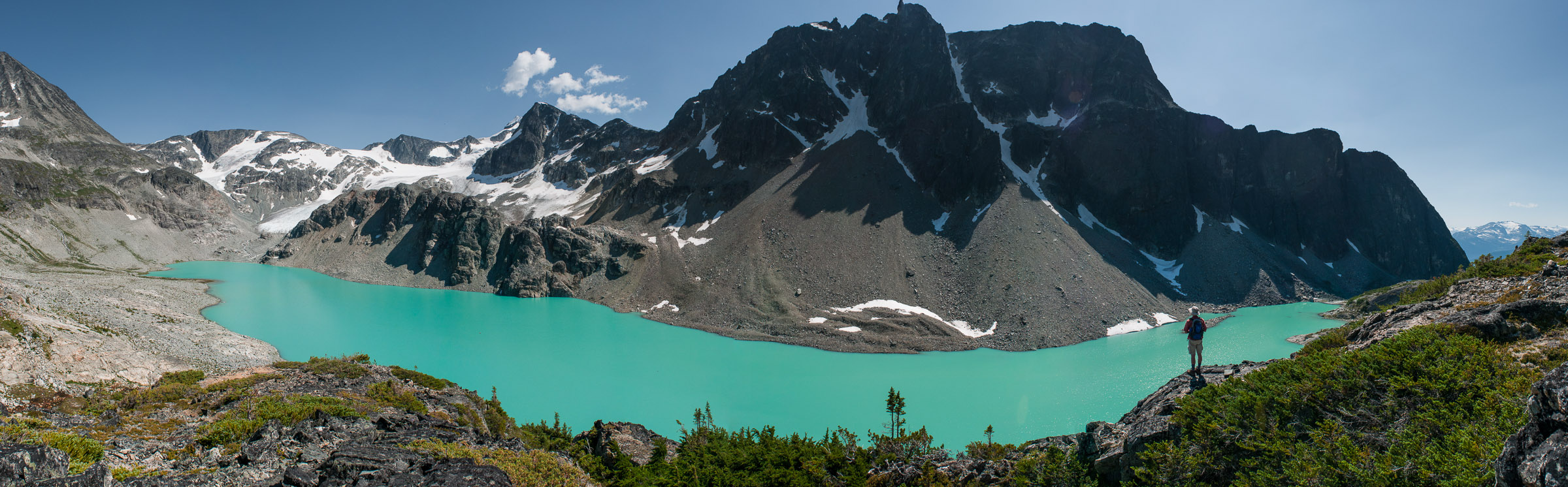
This hike is all about the destination. Wedgemount Lake is stunning - a bright turquoise
lake set high above the valley among stark glaciated mountains. The Wedgemount glacier,
alas, no longer reaches down to the lakeshore - yet another victim of glacial retreat -
but even in its current diminished state the setting here rivals the famous
Peyto Lake in the Canadian Rockies for
beauty. Best of all (and unlike at Peyto Lake, where you'll need to share the vista
with tour buses of tourists) here you might well have this world-class attraction virtually to yourself.
As you'll gather from the above, the hike to Wedgemount Lake is highly recommended.
There is, however, no mystery as to why you might find yourself alone in the cirque.
The trail is steep. And dull. And root-infested. Most frustrating of all, the outlet stream from the
lake thunders toward the valley via a spectacular waterfall, which the trail takes
pains to conceal from hikers. All in all, it's hard to
avoid the impression that BC Parks assigned their B team to the construction work here.
But the destination is worth the effort. Consider it an aerobic workout,
leave plenty of time to savor the awesome scenery at the lake, and you won't be
disappointed.
Remoter parts of the Coast Mountains
The Coast Range stretches for the better part of a thousand miles - from the US
border all the way up to the Yukon - and although the southern portion near
Vancouver isn't all that well protected (there's a lot of logging) there is still
an abundance of wilderness hikes. In planning our trip I made use of Kathy and
Craig Copeland's guidebook Don't Waste
your time in the BC Coast Mountains, which is recommended but currently out of
print. The hiking guide you'll find in local shops is
103 Hikes in
Southwestern British Columbia, which is dry but otherwise serviceable. Together, these
guides cover much of the area near Vancouver, which includes not just Garibaldi but also
Golden Ears, Stein Valley and Skagit Valley parks.
More alluring still are the peaks that lie further to the north of the Coast Range. These
include Mount Waddington, which
at 13,186 feet is actually higher than any of the peaks in the Canadian Rockies. You
can't drive (or hike, unless you're up for a month-long expedition) to anywhere that's
remotely close to the base of Waddington and the mighty glaciers that surround it, but there are
trails in the general vicinity that are most easily accessed out of the town of Bella Coola on
the Pacific Coast. Some trails lie within Tweedsmuir
Provincial Park, but there are many more listed on the website of the
Chilcotin Mountains Wilderness Society, which provides
the best - OK the only - guide to this region that I've found online.
[As an aside, Mount Waddington is so remote that it's quite a challenge to find a hike that
affords even a distant view of the peak. Your best bet is probably to hike to the top of
Perkins Peak in the Pantheon Range,
from where there is said to be a clear view of Waddington. The route is obvious on the maps available from the
Chilcotin Mountains Wilderness Society, and with a 4WD the hike - which I haven't done -
is supposed to be easy...]
Bears and bugs
If your wildlife worries in the Coast Mountains start and end with bears, you're making a mistake.
Although there are both grizzly and black bears in these mountains - and normal care is
certainly sensible - bugs will almost surely be your most pressing problem. In the peak
hiking season dense swarms of black flies, which will envelope you the moment you pause
to rest or eat lunch, are almost everywhere. Don't rely on insect repellant - take
long sleeved shirts and pants and a net for the head to be on the safe side for days
when they're particularly bad.
Practicalities
My brother and I stayed in